
Acupuncture for Rosacea in Calgary
Rosacea is one of the more misunderstood skin conditions — frequently dismissed as simple facial flushing or sensitivity, and managed primarily through avoidance of triggers and topical or antibiotic treatment that suppresses symptoms without addressing what's driving them. For many people with rosacea, the condition gradually worsens over years despite management, spreading across more of the face and becoming increasingly reactive to a widening range of triggers.
Traditional Chinese Medicine has a specific framework for rosacea — one that explains both why it develops and why it worsens over time, and that points toward a clear treatment approach. Rosacea in TCM is understood as a pattern of heat accumulating in the face and skin, driven by internal organ dysfunction rather than surface sensitivity alone.
For the full overview of how TCM approaches skin health, see Acupuncture for Skin Conditions in Calgary. If stress is a significant trigger, see Acupuncture for Stress in Calgary. If acne is also present alongside rosacea, see Acupuncture for Acne in Calgary.
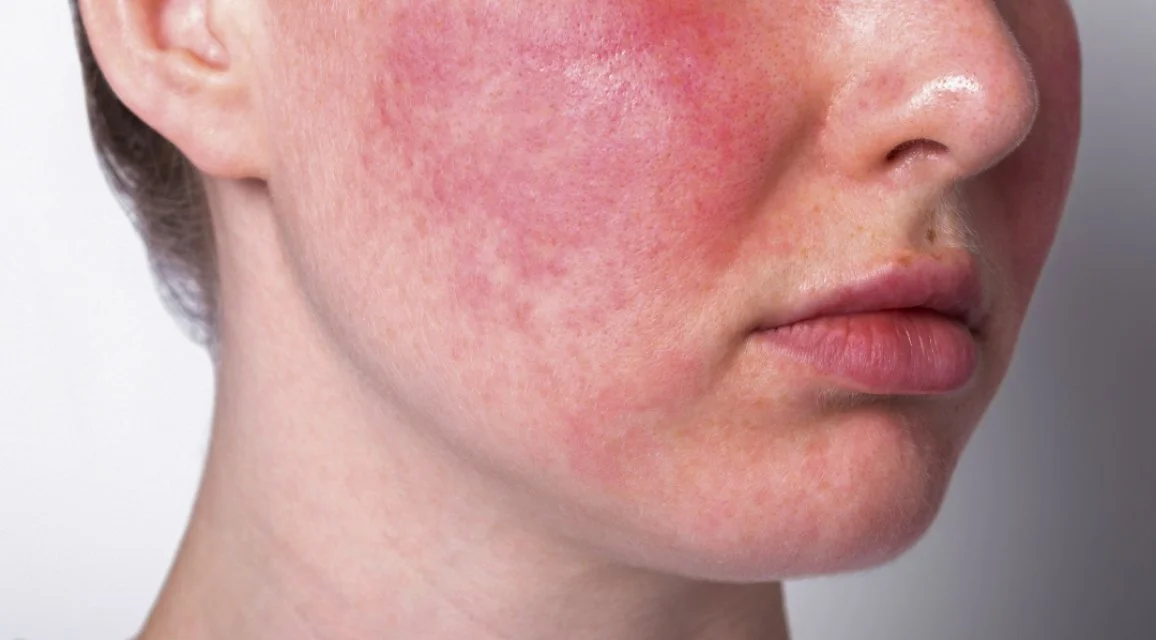
What Rosacea Is — The TCM View
In TCM, the face is traversed by multiple organ meridians — the Stomach, Large Intestine, Liver, Gallbladder, and Heart channels all pass through facial tissue. When heat accumulates in any of these systems, it rises along the channels and expresses itself through the skin of the face. This is the fundamental mechanism underlying rosacea in TCM — internal heat rising upward and becoming visible on the surface.
What distinguishes rosacea from other heat presentations is the chronic, persistent quality of the flushing and redness. Acute heat conditions flare and resolve. Rosacea persists because the internal heat pattern is sustained — continually generated by organ dysfunction, dietary factors, emotional constraint, or a combination of all three.
The classic rosacea triggers — alcohol, spicy food, heat exposure, emotional stress, sun — all share a common quality in TCM: they generate or amplify internal heat, which rises to an already heat-burdened face and produces the characteristic flushing and inflammation. Managing triggers reduces the surface expression of the pattern without reducing the underlying heat that makes the face so reactive in the first place.
The Most Common Rosacea Patterns in TCM
Stomach and Lung Heat Rising to the Face — The most common pattern underlying rosacea. The Stomach channel traverses the central face — the nose, cheeks, and chin — and when heat accumulates in the Stomach system, it rises along this channel and produces the classic rosacea distribution: redness concentrated on the nose and central cheeks, flushing that worsens after eating, and a reactivity to hot, spicy, and alcohol-containing foods. The Lung governs the skin and when Lung heat is present, the skin becomes reactive and easily flushed in response to heat exposure and environmental triggers. Treatment clears heat from both systems and reduces the inflammatory drive rising to the face.
Liver Qi Stagnation Generating Heat — One of the most common patterns in stress-reactive rosacea. Chronic stress constrains the Liver, generates heat, and that heat rises along the Liver and Gallbladder channels to the lateral face, temples, and cheeks. Flushing in this pattern is strongly stress-triggered — emotional activation, frustration, or periods of sustained demand reliably produce facial redness and heat. Accompanying signs include irritability, tension in the neck and shoulders, hypochondriac discomfort, and mood that tracks directly with stress levels. This pattern is frequently found alongside the Stomach and Lung heat pattern, with stress amplifying a baseline heat reactivity that dietary factors are sustaining. Treatment moves Liver Qi and clears the heat it generates — often producing a noticeable reduction in stress-triggered flushing alongside broader improvements in stress resilience.
Blood Heat — When heat enters the Blood, it drives a more intense and rapidly reactive form of rosacea — bright red flushing that appears quickly in response to triggers, significant warmth in the affected skin, and a tendency toward papules and pustules alongside the background redness. Alcohol and spicy food are particularly reliable triggers in this pattern, as both directly heat the Blood. Treatment cools and moves the Blood — reducing the intensity and speed of the flushing response as the Blood heat pattern is gradually addressed.
Yin Deficiency with Empty Heat — In longer-standing rosacea — particularly in women through perimenopause — Yin deficiency with empty heat is frequently an underlying or contributing pattern. As Yin declines, the cooling and anchoring function is lost and heat arises that is persistent rather than reactive — a background redness that doesn't fully resolve between triggers rather than a clear-and-flush pattern. Accompanying signs include night sweats, poor sleep, restlessness, and a general sense of internal heat that is worse in the evening. Treatment nourishes Yin and clears empty heat — a gradual process that requires a sustained course as Yin rebuilds slowly.
In practice, rosacea almost always involves a combination of patterns. Stomach heat alongside Liver Qi stagnation is extremely common — dietary factors sustain the baseline heat while stress repeatedly amplifies it, producing a condition that is both chronic and reactive.
Why Rosacea Worsens Over Time Without Root Treatment
Rosacea has a well-recognized tendency to progress — spreading across more of the face, becoming reactive to an increasing range of triggers, and transitioning from intermittent flushing to persistent redness and eventually to vascular changes and tissue thickening.
In TCM this progression makes clinical sense. When internal heat is sustained without being addressed at the root, it gradually damages the Blood and vessels in the affected tissue, produces Blood stasis in the facial vessels, and draws more of the organ system into the pattern. Triggers that didn't previously cause flushing begin to as the system's threshold for reactivity lowers. The condition becomes increasingly difficult to manage because the underlying pattern has deepened.
This is the strongest argument for addressing rosacea through its root pattern rather than trigger avoidance alone. Avoidance manages the surface expression of a pattern that continues to develop beneath it.
How Acupuncture Treats Rosacea
Treatment is guided by the pattern identified through diagnosis. For Stomach and Lung heat, treatment clears heat from both systems and reduces the inflammatory drive rising to the face — dietary guidance is central here, as the foods generating Stomach heat will consistently undermine treatment progress if not addressed. For Liver Qi stagnation with heat, treatment moves constraint and clears the heat it generates — stress management alongside needling produces better and faster results than needling alone. For Blood heat, treatment cools and moves Blood. For Yin deficiency with empty heat, treatment nourishes Yin and clears heat — the most gradual of the rosacea patterns, requiring patience as the foundational cooling resource is slowly rebuilt.
Dietary guidance is part of treatment for all rosacea patterns. Alcohol, spicy food, and excess sugar are the most consistently problematic for the heat patterns underlying rosacea and need to be significantly reduced during a course of treatment for meaningful progress.
What to Expect from Treatment
Your first appointment is 90 minutes and begins with a thorough intake — your rosacea history, when it started, how it has progressed, what triggers flushing, your stress, digestion, sleep, menstrual history if relevant, and overall health picture. Understanding the triggers that most reliably produce flushing is particularly useful — they point directly toward the underlying organ pattern.
Rosacea is a chronic condition that has typically been developing for years before treatment is sought. Meaningful improvement — reduction in baseline redness, reduced intensity and frequency of flushing, and a widening of the threshold for trigger reactivity — is typically felt within 6–8 sessions. More complete resolution of established rosacea requires a longer course of 10–12 sessions, and maintenance treatment is often beneficial for sustaining results in more deeply established patterns.
To learn more about what a course of treatment involves, visit the Acupuncture for Skin Conditions service page.
Acupuncture for Skin Conditions in NW Calgary
Dr. Joseph Coccagna is a Doctor of Acupuncture (Dr. Ac.) registered with the College of Acupuncturists of Alberta, practicing at The Natural Health Collective, 1607 20 Ave NW, in Capitol Hill, NW Calgary — serving patients across Capitol Hill, Mount Pleasant, Briar Hill, Banff Trail, West Hillhurst, Hillhurst/Kensington, St. Andrews Heights, and surrounding NW Calgary communities.
If rosacea has been affecting your confidence and conventional management hasn't produced lasting change, there is a root-cause approach worth exploring. Book a free 20-minute consultation and let's talk about what's driving it and what treatment looks like for your specific pattern.
FAQ: Acupuncture for Rosacea in Calgary
Can acupuncture reduce facial redness permanently?
Acupuncture addresses the internal heat pattern driving the redness — which means improvement in baseline redness and reduction in flushing reactivity are realistic outcomes of a sustained course of treatment. The degree of improvement depends on how long the condition has been present, how deeply the pattern is established, and how consistently dietary and lifestyle factors are addressed alongside needling. Longstanding rosacea with vascular changes takes longer to respond than more recently developed presentations.
Why does stress trigger rosacea flushing?
In TCM, chronic stress constrains the Liver and generates heat that rises along the Liver and Gallbladder channels to the face. In people with a baseline heat pattern — Stomach heat, Lung heat, or Blood heat — stress amplifies the existing heat and pushes it to the surface more intensely. Treating the Liver pattern reduces the stress reactivity of the skin alongside broader improvements in stress resilience. See Acupuncture for Stress in Calgary for more.
Why does alcohol trigger rosacea so reliably?
Alcohol directly generates heat in the Blood and Stomach in TCM — making it one of the most reliable triggers for the heat patterns underlying rosacea. Reducing or eliminating alcohol during a course of treatment is one of the most impactful dietary changes for rosacea, regardless of the specific pattern involved.
Can acupuncture help with rosacea that has been worsening over years?
Yes — though longer-standing rosacea that has progressed to persistent redness and vascular changes requires a longer course of treatment than more recently developed presentations. The underlying pattern has had more time to establish itself and deepen, and meaningful improvement requires sustained treatment over several months. Most patients with established rosacea notice a meaningful reduction in flushing intensity and trigger reactivity within a full course of treatment.
Can acupuncture help alongside topical rosacea treatments?
Yes — acupuncture does not interfere with topical treatments for rosacea and is commonly used alongside them. The goal of acupuncture is to address the internal pattern driving the condition — which topical treatment alone cannot do — while topical management continues to support the skin surface. Any changes to medication should be discussed with your prescribing physician or dermatologist.
Is acupuncture for rosacea covered by insurance in Alberta?
If your extended health benefits include acupuncture, yes. Dr. Coccagna is registered with the College of Acupuncturists of Alberta, satisfying the requirements of most major insurers. Read the full guide to acupuncture insurance coverage in Alberta.
Dr. Joseph Coccagna is a Doctor of Acupuncture (Dr. Ac.) registered with the College of Acupuncturists of Alberta, practicing at The Natural Health Collective, 1607 20 Ave NW, Calgary, AB.