
What Your Mouth Reveals About Your Health: A Traditional Chinese Medicine Perspective
In Traditional Chinese Medicine (TCM), the mouth is one of the clearest windows into what is happening inside the body. The teeth, gums, tongue, lips, breath, saliva and even the sense of taste each connect to specific organ systems and channels. When something shows up in the mouth, TCM asks what it is pointing to elsewhere.
This idea isn't foreign to modern dentistry either. Gum disease is now studied alongside cardiovascular disease and diabetes, and dentists are often the first clinicians to notice signs of acid reflux, teeth grinding or a dry mouth from medication. TCM takes the same instinct further, reading the mouth as part of one connected system.
This post walks through the main oral signs TCM pays attention to, what each can reflect about overall health, and where acupuncture and Chinese herbal medicine can work alongside dental care.
The Teeth and the Kidneys
In TCM, the Kidneys govern the bones and produce marrow, and the teeth are described in the classical texts as "the surplus of the bones." Strong, well-formed teeth reflect strong Kidney Essence (Jing), the deep constitutional reserve we inherit from our parents and draw on throughout life.
When Kidney Essence is weak, the teeth often show it. Signs TCM associates with Kidney deficiency include:
Recurring cavities despite good hygiene and a reasonable diet
Weak or chalky enamel, or teeth that chip easily
Loosening teeth or receding gums with age
Late or slow tooth development in children
Early tooth loss alongside other signs of Kidney decline, such as low back weakness, hearing changes, early greying or low bone density
Kidney Essence is depleted by chronic overwork, poor sleep, repeated pregnancies close together, long-term illness and ageing. This is why dental problems often cluster with other "wear" signs in the body. From a TCM perspective, a patient with recurring decay is not only asked about sugar and brushing, but also about energy, sleep, stress and bone health.
Kidney Yin deficiency adds heat to the picture: dry mouth, gums that bleed easily, tooth pain that is dull and worse at night, and a red tongue with little coating. Kidney Yang deficiency tends toward coldness, fatigue and teeth that feel sensitive to cold.
Pregnancy and postpartum show this connection clearly. Many women notice bleeding gums, slightly loose teeth or new cavities during pregnancy or in the year after birth. In Western terms, hormones make the gums more reactive and loosen the ligaments that hold the teeth. Morning sickness, reflux, cravings and broken sleep also raise the risk of decay. Despite the old saying, the baby does not draw calcium out of the mother's teeth.
From a TCM perspective, growing and nourishing a baby draws heavily on Kidney Essence and Blood, and the postpartum period is a time of Qi, Blood and Yin depletion. Dental changes in this window are a sign that those reserves need rebuilding, especially after pregnancies close together, a difficult birth, significant blood loss or long months of breastfeeding on little sleep. Gums that are red, swollen and bleeding during pregnancy can also reflect Heat in the Stomach, since pregnancy itself tends to generate Heat.
The Gums and the Digestive Channels
Where the teeth belong to the Kidneys, the gums belong to the digestive system, for two reasons. First, the channels: the Stomach channel runs into the upper gums and the Large Intestine channel into the lower gums. This is why classical acupuncture treats upper toothache with points on the Stomach channel and lower toothache with points on the Large Intestine channel, including the well-known point between the thumb and index finger. Second, the Spleen governs the flesh, and the gums are flesh. The Spleen and Stomach are a Yin-Yang pair that work together as the core of digestion, so the health of the gums reflects the health of that system.
The condition of the gums often mirrors the state of digestion:
Red, swollen, painful gums that bleed with brushing, often with bad breath, thirst and a preference for cold drinks, point to Stomach Heat. This is common with heavy, spicy, greasy or alcohol-rich diets.
Pale gums that bleed easily without much swelling or pain point to Spleen Qi Deficiency, where the Spleen is too weak to hold Blood in the vessels. These patients often also bruise easily, feel tired after eating and have loose stools.
Receding gums and loosening teeth with mild, chronic bleeding point back to the Kidneys, often Kidney Yin Deficiency.
Persistent gum problems are a natural place for dental care and TCM to work together. The dental team treats the gum tissue directly, while TCM looks at the digestive and constitutional patterns that may be feeding the inflammation.
Specific Teeth and Specific Organs
You may have seen charts linking each tooth to an organ and a meridian. It's worth being clear about where these come from. The tooth-organ chart is not part of classical Chinese medicine. It was developed in Germany in the 1950s by Dr. Reinhold Voll and colleagues, as part of a system called electroacupuncture according to Voll, and it borrows the TCM organ pairs. It is widely used in biological and holistic dentistry, but it has not been validated by research, and the details differ from chart to chart.
The general layout most charts share:
Central and lateral incisors: Kidney and Bladder
Canines (cuspids): Liver and Gallbladder
First and second premolars (bicuspids): Lung and Large Intestine (upper), Spleen and Stomach (lower)
First and second molars: Spleen and Stomach (upper), Lung and Large Intestine (lower)
Third molars (wisdom teeth): Heart and Small Intestine
The premolars and the first and second molars are where charts differ most. Some reverse the upper and lower assignments, and others split the organs by the left and right sides of the mouth.
Used sensibly, the map is a prompt for questions rather than a diagnosis. A recurring problem in one area of the mouth, especially one that doesn't respond to standard treatment, is a reasonable cue to look at the related organ system. It should never be the sole reason for extracting a tooth or for concluding that a distant illness is "caused" by a tooth.
Bad Breath (Halitosis)
When bad breath persists after the teeth, gums and tongue have been properly cleaned, TCM looks to the digestive tract. The common patterns are:
Stomach Heat: strong, foul breath with thirst, a big appetite, red or swollen gums, mouth ulcers and sometimes constipation. The tongue is red with a yellow coating.
Damp-Heat in the Spleen and Stomach: a heavier, sour or rotten smell, a sticky or sweet taste in the mouth, bloating, a sluggish feeling after meals and loose or sticky stools. The tongue has a thick, greasy yellow coating.
Food Stagnation: a sour, fermented smell with belching, reflux and a full, uncomfortable stomach, often after overeating or eating late at night.
Lung Heat: bad breath that comes with a sore throat, post-nasal drip, sinus congestion or yellow mucus.
In each case, the breath is the symptom and the digestion or respiratory system is the root. Treating the root through acupuncture, herbs and diet is what makes the change last.
Acid Reflux and Enamel Erosion
Dentists are often the first to spot silent reflux. Stomach acid that rises into the mouth wears away enamel, usually on the inner surfaces of the back teeth, and can do so before the person ever feels heartburn.
In TCM, the Stomach's Qi is meant to descend. Reflux is Stomach Qi rebelling upward, and the question is what is pushing it:
Liver Qi overacting on the Stomach: reflux that flares with stress, frustration or tension, along with belching, sighing and a tight feeling under the ribs. This is one of the most common patterns in practice.
Stomach Heat: burning reflux, a sour taste, strong thirst and hunger, worse with spicy food, coffee and alcohol.
Stomach Yin Deficiency: a milder, gnawing discomfort with a dry mouth and throat, poor appetite and a red, peeled or cracked tongue.
Spleen Qi Deficiency with Food Stagnation: reflux after heavy or late meals, bloating and fatigue after eating.
This matters for dental care because the enamel won't stop eroding until the reflux settles. Protective treatments in the dental chair and work on the digestive pattern are complementary rather than competing.
Mouth Ulcers, Dry Mouth and Burning Mouth
Mouth ulcers (canker sores) are almost always read as Heat in TCM, but where the Heat comes from changes the treatment:
Heart Fire: ulcers on the tip of the tongue, flaring with stress, poor sleep and emotional strain.
Stomach Heat: large, very painful ulcers on the gums and inner cheeks, with bad breath and thirst.
Yin Deficiency Heat: small, recurring ulcers that are less painful but slow to heal, worse with fatigue and late nights.
Spleen Qi Deficiency: pale, slow-healing ulcers that recur when the person is run down.
Dry mouth is often a medication side effect and should be checked medically, especially when paired with dry eyes. From a TCM perspective, a dry mouth with thirst and night sweats points to Yin Deficiency of the Stomach or Kidneys. A dry mouth without much desire to drink points instead to Dampness, where the Spleen isn't moving fluids up to the mouth properly.
Burning mouth, with no visible cause in the mouth itself, is commonly seen as Yin Deficiency with Heat, often involving the Heart and Kidneys, and frequently shows up around menopause.
Clenching, Grinding and Jaw Pain
Worn, flattened or cracked teeth, scalloped edges on the tongue, and sore jaw muscles are things a dentist sees every day. A night guard is essential for protecting the teeth, and TCM can work alongside it by addressing why the jaw is working so hard in the first place.
The Stomach, Gallbladder, Small Intestine and San Jiao channels all pass over the jaw, and the Liver governs the sinews and the smooth flow of Qi. Clenching and grinding are most often read as:
Liver Qi Stagnation: stress held in the body, with tension in the neck, shoulders and jaw, irritability and tension headaches.
Liver Yang Rising or Liver Fire: grinding with headaches at the temples, a red face, a short temper and disturbed sleep.
Liver Blood Deficiency: tight, cramping muscles that don't fully relax, often with poor sleep and dry eyes.
Stomach Heat or Food Stagnation: night grinding linked to late or heavy meals, especially in children.
Many of these patients are also dealing with a dysregulated nervous system, where the body stays braced even during sleep. Acupuncture for jaw pain and temporomandibular disorders (TMD) has a reasonable research base, and treatment addresses both the local muscles and the stress pattern underneath.
The Tongue, Lips, Saliva and Taste
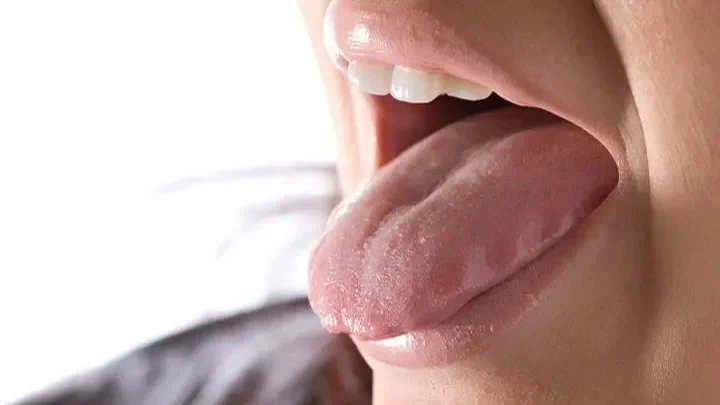
The tongue is one of the main diagnostic tools in TCM, and it sits right in front of the dentist at every appointment. Different areas of the tongue reflect different organ systems: the tip reflects the Heart and Lungs, the centre the Spleen and Stomach, the sides the Liver and Gallbladder, and the back the Kidneys and Intestines. Beyond location, TCM looks at:
Colour: pale suggests Qi or Blood Deficiency, red suggests Heat, and purple suggests Blood Stasis.
Shape: a swollen tongue with tooth marks along the edges (scalloping) suggests Spleen Qi Deficiency and Dampness. A thin tongue suggests Blood or Yin Deficiency.
Cracks: a deep central crack points to the Stomach, and many fine cracks to Yin Deficiency.
Coating: a thin white coating is normal. A thick or greasy coating shows Dampness or Food Stagnation, a yellow coating shows Heat, and a peeled or patchy ("geographic") coating points to Stomach Yin Deficiency.
The lips belong to the Spleen. Pale lips suggest Blood or Qi Deficiency, dry red lips suggest Heat, cracking at the corners of the mouth suggests Stomach Heat or Yin Deficiency, and bluish lips suggest poor circulation or Blood Stasis.
Saliva is produced by the Spleen and the Kidneys. Excess thin saliva or drooling, especially at night, is a classic sign of Spleen Qi Deficiency. Reduced, sticky saliva points to Yin Deficiency or Heat.
Taste carries information too. A bitter taste suggests Liver and Gallbladder Heat or Heart Fire. A sweet or sticky taste suggests Damp in the Spleen. A sour taste suggests the Liver invading the Stomach. A salty taste points to the Kidneys, and a dull or absent sense of taste to Spleen Deficiency.
Children's Oral Health
In TCM, children are born with a naturally immature Spleen and still-developing Kidneys. That is why digestion and growth are where most children's imbalances show up, and the mouth reflects both.
Teething that is especially painful, with red cheeks, drooling, irritability and loose or green stools, is often read as Heat in the Stomach on top of a still-developing digestive system.
Night grinding in children is commonly linked to Food Stagnation (eating late, eating too much, or too many rich and sweet foods) or to Heat affecting sleep.
Persistent drooling past the teething stage points to a weak Spleen.
A geographic tongue, with patchy, map-like areas missing coating, points to Stomach Yin Deficiency or long-standing Food Stagnation.
Mouth breathing, snoring and chronic congestion are often tied to Phlegm from a weak Spleen and Lungs. These children are frequently picked up by dentists and orthodontists because of how mouth breathing affects jaw and palate development.
Early or frequent cavities, delayed tooth eruption or weak enamel can point to Kidney Essence that needs more support.
Children respond quickly to treatment. Paediatric acupuncture uses very few, very brief needles or none at all, relying instead on gentle non-needle techniques, paediatric massage (tuina) and simple dietary changes.
When a Dentist Might Refer to an Acupuncturist
Dentists see patients more regularly than almost any other health professional, often every six months for years. That puts them in a unique position to notice patterns early. These are some of the situations where a referral to a Doctor of Acupuncture can complement dental care:
Clenching, grinding and TMD: jaw pain, worn teeth or tension headaches, where treating the underlying stress and muscle tension can complement a night guard.
Signs of acid reflux: enamel erosion on the inner surfaces of the teeth, especially when the patient isn't aware of heartburn.
Persistent bad breath: halitosis that remains after the mouth itself is healthy.
Recurring mouth ulcers: frequent canker sores, especially when they track with stress or fatigue.
Dry mouth and burning mouth: once medical causes have been looked at, particularly around menopause.
Bleeding or inflamed gums: gum problems that don't improve as much as expected with good hygiene and periodontal care.
Recurring decay or weak enamel: ongoing cavities in a patient with good habits, especially alongside fatigue, poor sleep or bone density concerns.
Facial pain and nerve pain: including trigeminal neuralgia and atypical facial pain without a dental cause.
Dental anxiety and a strong gag reflex: acupuncture is used to calm the nervous system before appointments, and there is research on specific points for reducing the gag reflex during procedures.
Recovery after procedures: support for pain, swelling and healing after extractions and oral surgery.
Children: mouth breathing, night grinding, difficult teething, geographic tongue and drooling past the teething years.
A tongue that tells a story: a heavily coated, swollen, scalloped, cracked or peeled tongue that suggests the digestive system needs attention.
A dental team that knows these connections can catch problems earlier and give patients another avenue of support alongside the care they already receive in the chair.
Treating the Mouth as Part of the Whole
The mouth is where digestion begins, where stress gets clenched and held, and where the body's deeper reserves show their wear. Dentistry protects and restores the teeth and gums. TCM adds a complementary lens, looking at the patterns that can place those structures under strain and treating them through acupuncture, Chinese herbal medicine, diet and lifestyle. Together, they give patients more complete care.
If you're dealing with any of the issues above, or your dentist has suggested looking deeper, you can book an appointment to look at what's going on underneath.
Dr. Joseph Coccagna is a Doctor of Acupuncture (Dr. Ac.) registered with the College of Acupuncturists of Alberta, practicing at The Natural Health Collective, 1607 20 Ave NW, Calgary, AB.